The Third Door
As companies stay private longer than funds can wait, a structural mismatch has quietly forced a third path into existence: the secondary market.

As we wrote in “While Everyone Waited For An IPO, The Real Value Was Made Elsewhere”, the IPO is not dead, it just arrives later in the story.
The same forces that delayed IPOs, extended company lifecycles, and stretched venture fund durations have created a growing mismatch between company timelines
and investor timelines.
The longer companies stay private, the more pressure builds inside the private market. That pressure is now turning into one of the most important opportunities in venture capital:
Secondaries.
Secondaries are not new, but the scale, urgency, and frequency of the need has changed.
Venture is moving from a market where liquidity happened mostly at the end of the company journey to one where liquidity can happen throughout it.
Great companies do not take a few years to build, they may need 15 years to reach their full potential, meanwhile a fund may need to return capital in 10. That mismatch is now everywhere.
Historically, solving that mismatch required a company-level exit. Today, that is where secondaries enter the picture.
A common mistake is to think of secondaries as exits. They’re not.
An IPO is a company-level event, an acquisition is a company-level event. A secondary is usually an owner-level event. Secondaries separate company liquidity from shareholder liquidity.
One of the reasons secondaries are so interesting is that many sellers are not selling because they have lost conviction in the company.
In many cases, the company itself is doing well. The seller’s decision has less to do with fundamentals and more to do with timing.
In public markets, these situations are usually absorbed quickly. Thousands of investors can buy a stock at any given moment, information is widely available, and liquidity is abundant.
Private markets work differently. There are fewer buyers, less transparency, transfer restrictions, company approvals, and a more complex transaction process. All of that creates friction. And friction can create opportunity.
Because sellers are often motivated by liquidity needs, investors can sometimes acquire stakes in high-quality private companies at attractive prices. The opportunity is not finding companies that everyone believes are broken, it is finding situations where a good asset ends up in the hands of a seller who simply needs liquidity before the company reaches its final destination.
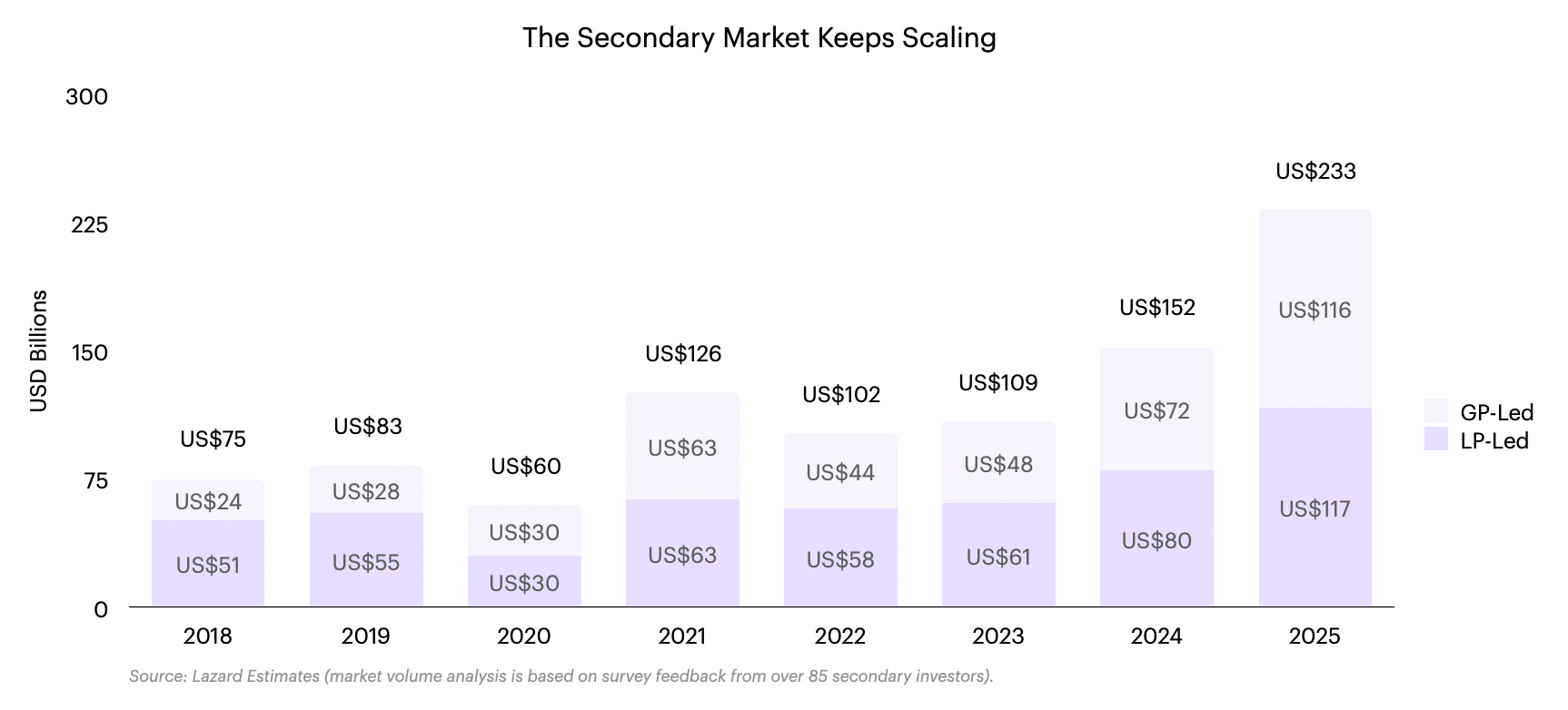
Lazard estimates that global secondary deal volume reached $233 billion in 2025, up 53% from $152 billion in 2024. It expects the market to reach roughly $275 billion in 2026. GP-led and LP-led secondaries were almost evenly split in 2025, with $116 billion of GP-led volume and $117 billion of LP-led volume.
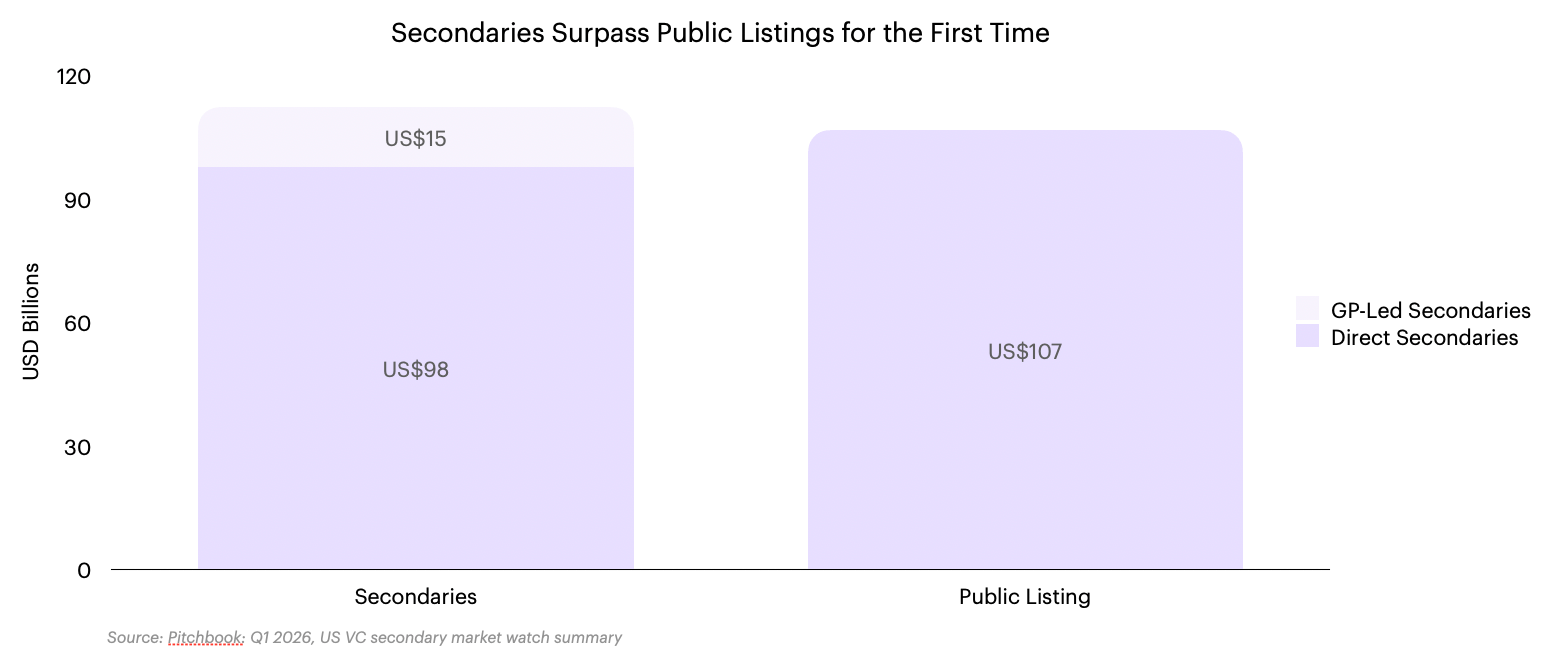
PitchBook estimates that the US venture secondary market reached an annualized value of $112.2 billion in Q1 2026, exceeding public listings for the first time. That includes an estimated $97.6 billion of direct secondaries and $14.6 billion of GP-led secondaries.
That mismatch between company timelines and investor timelines runs through every layer of the private market and it’s generating demand for secondaries from multiple directions at once.
The clearest example at the fund level is the rise of GP-led secondaries. A continuation vehicle allows the GP to move one or more assets into a new vehicle, often giving existing LPs the option to sell for cash or roll into a new structure, offering the asset more time to compound.
Industry Ventures describes a spectrum of these structures, from asset sales and strip sales to LP tenders and preferred LP commitments. The common theme is that fund managers now have more tools to solve liquidity without forcing a traditional exit.
The same tension plays out at the company level, but for a different set of stakeholders. If a company stays private for 12 years, employee equity cannot remain theoretical forever. At some point, paper wealth needs a release valve, and increasingly, companies are providing one through tender offers.
PitchBook notes that the average time between tender offers on Nasdaq Private Market fell from 899 days in 2022 to just 132 days in 2025. Tender offers are a way for companies to stay private longer without asking employees and early shareholders to wait indefinitely.
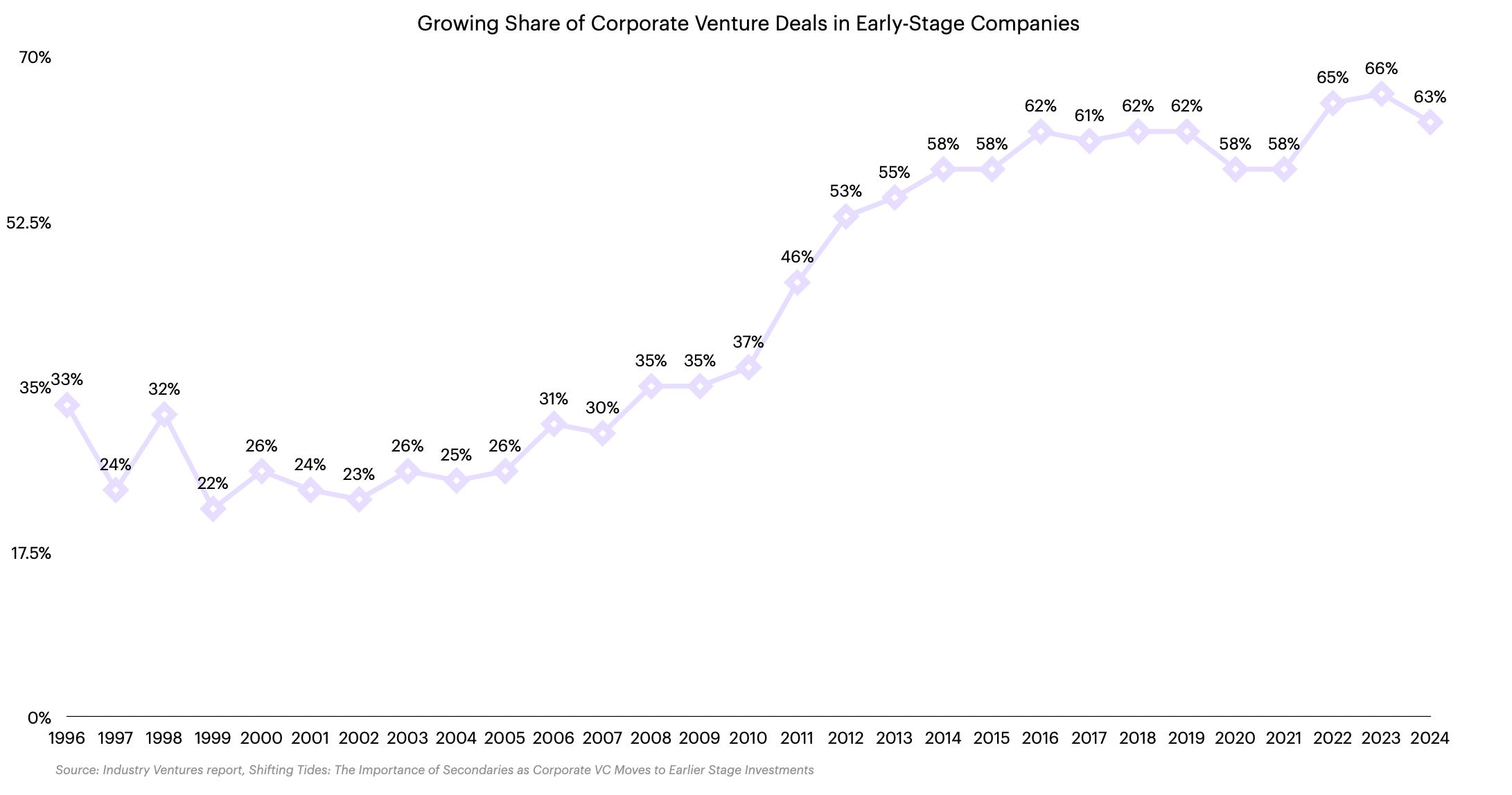
Corporate venture capital creates a third version of the same problem. CVCs have moved earlier over the last decade. Industry Ventures notes that while CVC activity once concentrated on later-stage companies, roughly two-thirds of CVC deals are now directed toward early-stage companies.
The result is orphaned positions: good companies that no longer fit the parent’s strategy. Secondaries allow CVCs to prune those portfolios, generate liquidity, and reallocate toward what matters now.
Different holders. Same mismatch. The asset still has time to run, but its owners don't. Secondaries are how the market bridges that gap.
None of this means secondaries are a perfect market — no market is.
The biggest challenge today is concentration. PitchBook found that the top 20 startups accounted for 81.1% of secondary trading value on Hiive in Q1 2026. The top five alone represented 44.6%. Caplight data showed that 75% of SPVs with carry were concentrated in just five names: SpaceX, Anthropic, OpenAI, xAI, and Anduril.
PitchBook argues that mega-IPOs from SpaceX, OpenAI, and Anthropic could reshape the market. Once those companies go public as SpaceX has already opened the door, their secondary trading activity moves to the public market, leaving a temporary vacancy in private secondary volume.
Secondaries will need to prove they can become real infrastructure rather than just a hot market, following the mega IPOs we are now witnessing.
Venture capital is moving from episodic liquidity to continuous liquidity. Secondaries are no longer a workaround for when IPO windows close. They are becoming one of the standard ways the private market functions.
Venture used to have two primary liquidity paths: IPO and M&A. It now has a third. This third path will not replace the first two, but it will increasingly sit alongside them, filling in the gaps that a longer private company lifecycle inevitably creates.
The first stage of the private market shift was about capital. Private markets became large enough to fund companies for longer.
The second stage is about liquidity. Private markets now need to become sophisticated enough to let ownership change hands before the final exit.
As private companies remain private longer and secondary transaction volume keeps growing, secondaries may become a more common source of liquidity for many venture-backed companies than traditional public listings.